Kshetraveda
Ghee and honey had a nostalgia problem. We launched Kshetraveda, a D2C food brand built for a generation that reads the label.
D2C FMCG Brand
Branding + Packaging + Shopify Store
Role
360° Brand Launch & Social Media
Timeline
8 weeks
team
Graphic Designer
platform
Web
Launching a D2C Food Brand From Scratch
Kiran Nayak grew up in a farming family in Telangana. Then he studied food technology and learnt what actually goes into the food most of us buy.
Once you know that, you can't un-know it.
He could have complained about the industry. Instead he decided to build the honest version: A2 bilona ghee and raw honey that are pesticide-free, lab-tested and traceable to the farm. He came to us with that conviction and nothing else. No identity, no packaging, no store, no story yet.
We liked him immediately. A founder who would rather do it properly than do it fast is rare, and it's exactly the kind of brand we want to build.
So we built Kshetraveda from zero: brand strategy, positioning, visual identity, FMCG packaging design, sourcing stories, the website and Shopify store, and the social media we still run today.

Brand Positioning for Gen Z: Good Food, No Nostalgia
So we made the call that shaped everything else: no nostalgia. None.
Kshetraveda wouldn't sell how food used to be. It would sell how food should be, right now. The positioning came down to one honest sentence: this is good for you, here's exactly why, and here's the proof.
We let the proof do the talking. Every batch is lab-tested for pesticides, and the report is public before you buy. Most brands hide their testing in fine print. We put it on the main navigation.
We gave the brand a voice that doesn't sell. It doesn't shout "authentic taste." It tells you, plainly, that real bilona ghee takes curd, churning and "a lot of waiting," and that a suspiciously cheap jar "deserves a second look." That honesty is what builds trust with a sceptical audience.
We kept the tradition and dropped the sentimentality. Bilona churning and wild-gathered honey aren't romantic throwbacks here. They're simply the better method, and that's the only reason they matter.
We made it everyday. Not a festive indulgence or a gift for your parents. Ghee on your rice. Honey in your morning. Part of a routine, not a ritual.
Then we gave it a line to stand on: "From the soil to your soul." It's about where your food comes from, never when.

Ghee & Honey Packaging Design: Nothing to Hide
If the brand's promise was honesty, the packaging had to prove it before anyone read a word.
So we chose glass. Clear glass with a gold lid. No opaque tub, no clever window. You see the slow-cooked grain of real bilona ghee, the thick, dark amber of wild honey, exactly what you're paying for. We wanted the jar to win the argument on its own.
Two shapes so you never have to read. Ghee sits in a sturdy round 500ml jar. Honey sits in a hexagonal 250g jar, the shape of a honeycomb cell. On a shelf or in a tiny product thumbnail, you know what you're looking at instantly.
Every product gets a colour of its own. Saffron-orange for A2 Gir Cow Ghee. Deep, almost-maroon for Raw Wild Forest Honey. Each one has its own personality while staying obviously part of one family.
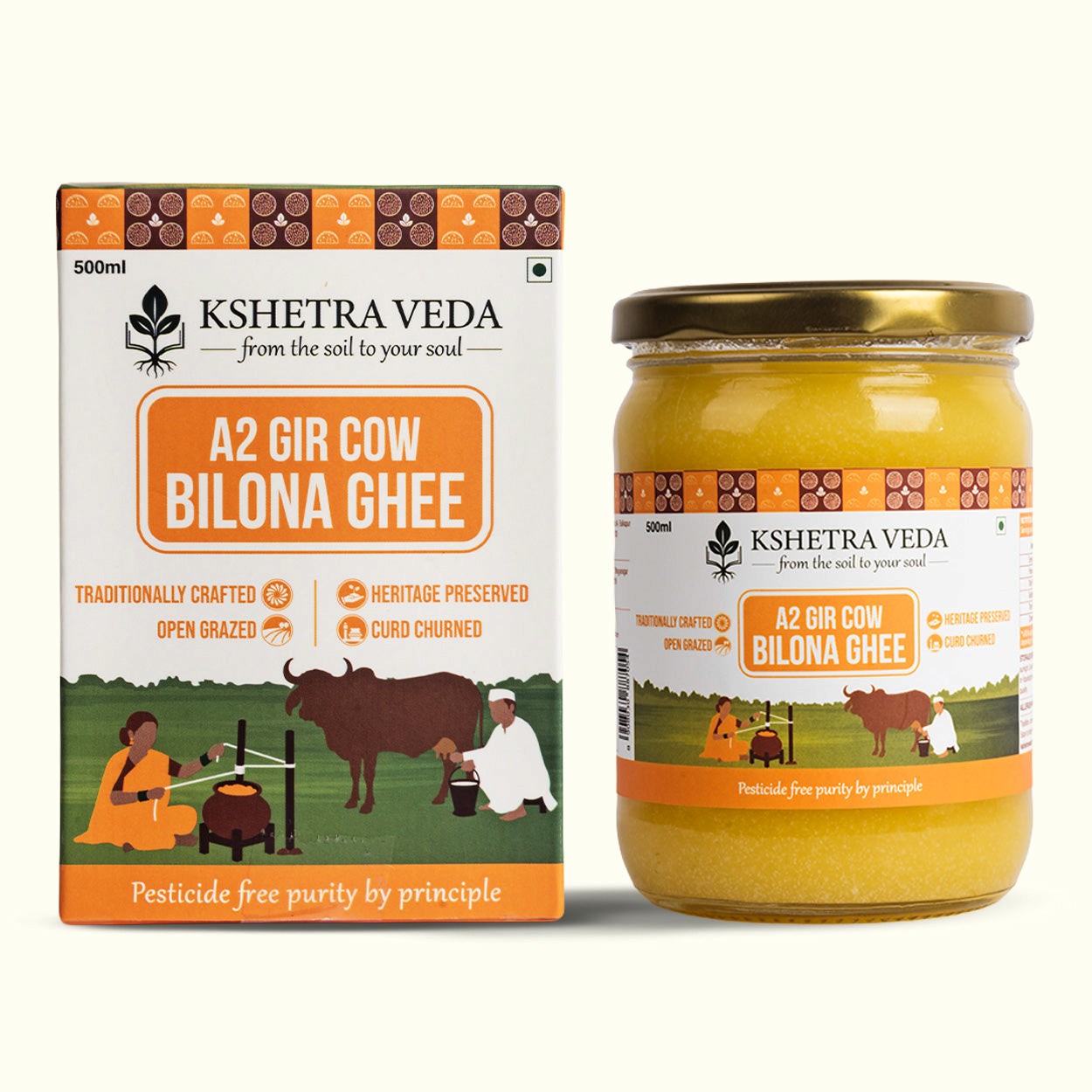
And underneath, a label system built to last. Every label stacks the same way: a band of geometric motifs drawn from Indian block prints, then the wordmark and its tree-and-roots emblem, then the product name in bold condensed caps you can read from across a room, then an illustrated scene of where it came from, and finally the promise at the bottom: Pesticide free purity by principle.
Fix the system once and every future product has a home. No redesign needed.

Label Design, Illustration & the Unboxing
We refused stock photos of happy cows. Every brand uses them, and nobody believes them. Instead, each label carries a flat, graphic illustration of the real process. On the A2 Gir Cow Ghee, a woman works a bilona churn while a Gir cow grazes behind her and a farmer milks in an open green pasture. The honey labels fold into layered forest hills.
It's deliberately modern: bold shapes, flat colour, no sepia, no vintage filter. It shows the tradition without asking you to feel homesick for it.
We turned the process into four icons: Traditionally Crafted. Open Grazed. Heritage Preserved. Curd Churned. That's the whole "why is this better" argument, readable in under two seconds.
We wrote the back of the jar for people who actually read it. That's our audience, after all. There's a clean nutrition table. There's a storage note explaining that ghee turns grainy or liquid with the weather, so nobody thinks their jar has gone bad when it's simply behaving like real ghee. There's the FSSAI licence, a QR code back to the brand, and a short note from the founder, signed by hand.
Then we made opening it feel like something. The ghee ships in a printed carton that wraps the whole illustrated world around the jar. It protects the glass, and it turns a delivery into a moment people want to post. They do: customer reviews keep calling out the premium feel and how carefully it arrives.

The Challenge: Ghee Had a Nostalgia Problem
Walk down any aisle in India and every ghee jar is selling you the same thing: your grandmother.
Golden-hour kitchens. Village courtyards. "Just like Nani used to make." For decades the whole category has run on memory. It works, if you have that memory and you're the one buying.
But a 24-year-old ordering groceries on their phone at midnight isn't buying a memory. They're reading the back of the jar, googling "A2 vs regular ghee," and closing the tab the moment something sounds like marketing.
And every brand says the same four words: pure, organic, desi, natural. Said that often, they mean nothing.
Add a price tag above ₹1,700 and the stakes were clear. Kshetraveda had a few seconds on a phone screen to earn the trust of a stranger who had been lied to by food labels all their life.

Sourcing Stories, Shopify Store & Social Media
Sourcing Stories
A promise of traceability means nothing unless you can actually trace it. So we did. We followed each product back to its source and told that story properly:
A2 Gir Cow Ghee: the heritage Gir breed, raised on small family farms and free to graze
A2 Desi Cow Ghee: Pahadi cattle in the Himalayan foothills
Raw Wild Forest Honey: gathered, never farmed, by tribal honey collectors in the forests around Haridwar, Rishikesh, Rajaji and Jim Corbett
Raw Multiflora Honey: seasonal blossoms across Jammu and Himachal Pradesh
These became the backbone of everything the brand says.
Website & Shopify Store Setup
We built kshetraveda.com on Shopify to work like the jar: transparent at every step. Every product page shows where it came from, what it costs per gram, and its lab report as a one-click download. Alongside the shop are the Our Story, Journal, Recipes and Lab Report pages, so the curious can go as deep as they like.
Social Media, Still Going
Launch was the beginning. We still run Kshetraveda's social media today, turning sourcing, lab results and everyday recipes into content for people who want to know what's in their food.
Kiran wanted to build the honest version. We just made sure people could see it.
Building a brand that deserves to be trusted? See what we do or let's talk.

